Project at a Glance
Levels Affected
Days to Completion
Structure Saved
Service ZIP
Executive Summary
When a middle-of-the-night water intrusion event struck a Lancaster County, PA 17602 residential property, the damage cascaded across three separate levels — a finished basement entertainment suite, a main-floor living zone, and an upper-level bathroom and bedroom. Harrisburg Restoration mobilized for an emergency restoration near Lancaster immediately, arriving in the overnight hours to begin stabilization before catastrophic structural losses could occur.
This case study documents a complex, multi-phase reconstruction services project that required far more than simple water extraction. Floor joists and sleepers had to be surgically removed to access trapped water and saturated insulation beneath a finished slab system. A high-value pool table could not be relocated due to space limitations, requiring technicians to frame around it. High-end interior finishes — custom-built wainscoting, hardwood-style entertainment flooring, and upscale bedroom materials — demanded thorough documentation and carrier-approved material matching before a single replacement board was installed. Containment systems were erected throughout to protect the homeowner, who has documented health limitations.
The result: a fully restored, structurally sound home with level-matched new floors, documented carrier compliance at every phase, and zero long-term moisture intrusion — all achieved without displacing a homeowner who could not easily leave the property.
“This project required the full depth of our reconstruction services capabilities — structural repair, carrier documentation, containment protocols, and precision finish matching — all delivered while protecting a homeowner with serious health considerations.”
Why Fast Response Matters
Water Damage Progression Timeline
Understanding the Incident
The Source: Overnight Water Intrusion Event
The loss originated during the overnight hours, when water began migrating through multiple building assemblies in this Lancaster County residential property. Because the incident occurred in the middle of the night, water had already begun its lateral spread through floor systems before discovery. By the time the homeowner recognized the scope of the problem and contacted Harrisburg Restoration for emergency restoration near their Lancaster, PA 17602 address, the damage had already penetrated the finished basement entertainment suite, the main-level living areas, and an upper-level bathroom and adjoining bedroom.
Multi-Level Water Migration
Water does not respect floor boundaries in a multi-story structure with complex framing systems. The mechanics of this loss illustrate precisely why early intervention through comprehensive reconstruction services is critical. Water that enters a finished basement entertainment suite — particularly one constructed with a sleeper-and-subfloor system on top of a concrete slab — is highly resistant to conventional extraction methods. The sleepers (horizontal framing members installed directly over the slab to create a raised subfloor) had trapped significant volumes of water beneath the finished floor assembly, where standing moisture was simultaneously saturating fiberglass batt insulation installed within the joist bays.
On the floors above, bathroom plumbing systems and their surrounding assemblies had also been affected, and the adjacent bedroom — with flooring, wall systems, and baseboards — required full demolition-and-rebuild sequencing before any meaningful drying could occur. The scale of this multi-level scenario demanded reconstruction services planning, not just mitigation response.
Property Profile
Location: Lancaster County, PA 17602
Property Type: Multi-level residential home
Affected Zones: Finished basement entertainment suite (bar area, pool table room, utility corridor), main-level living areas, upper-level bathroom and bedroom
Incident Timing: Middle-of-night water intrusion event
Special Circumstances: Homeowner with documented health limitations; high-end interior finishes; pool table unable to be relocated
Property Assessment and Scope of Damage
Basement Level: Entertainment Suite — Primary Impact Zone
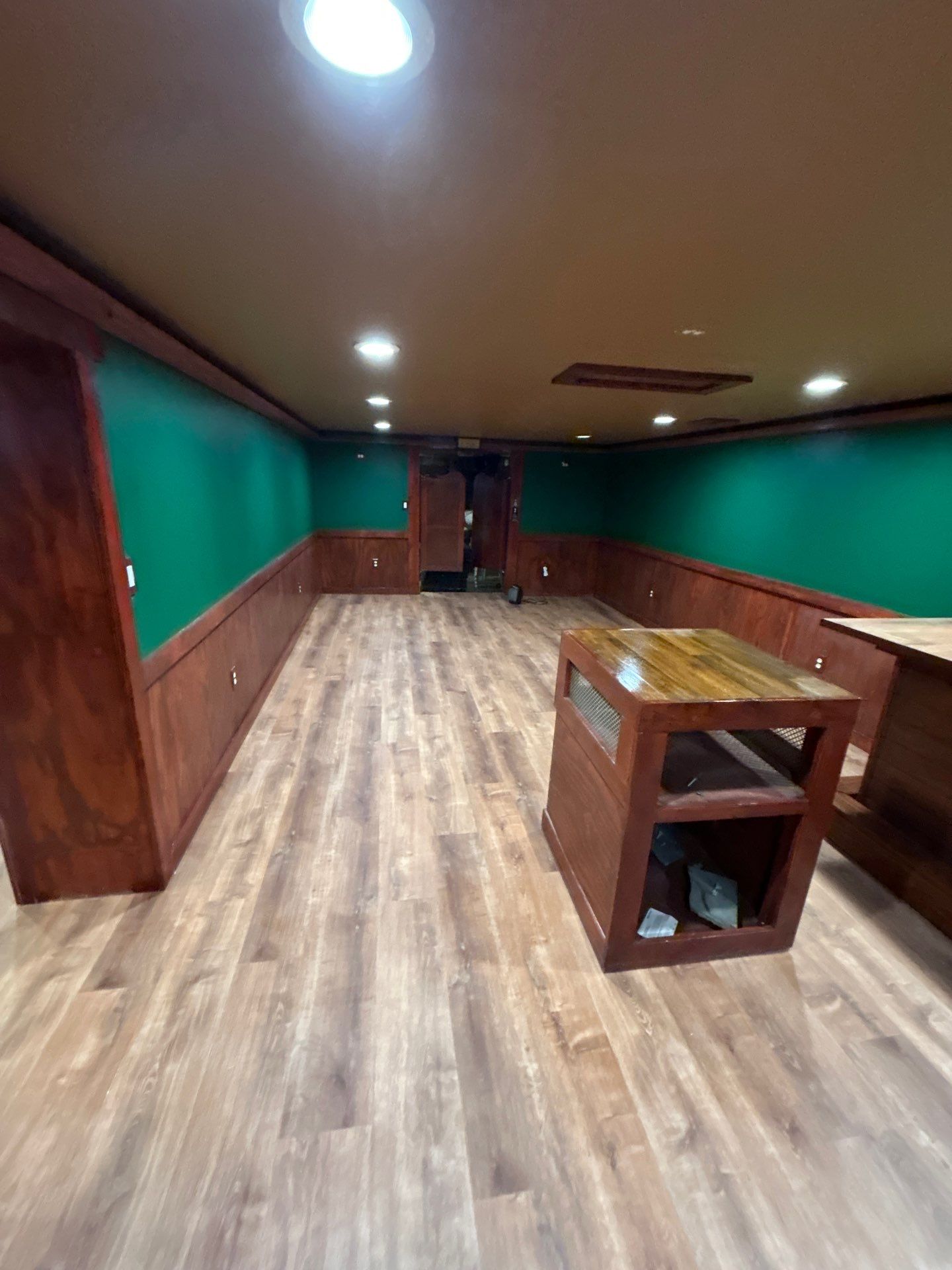
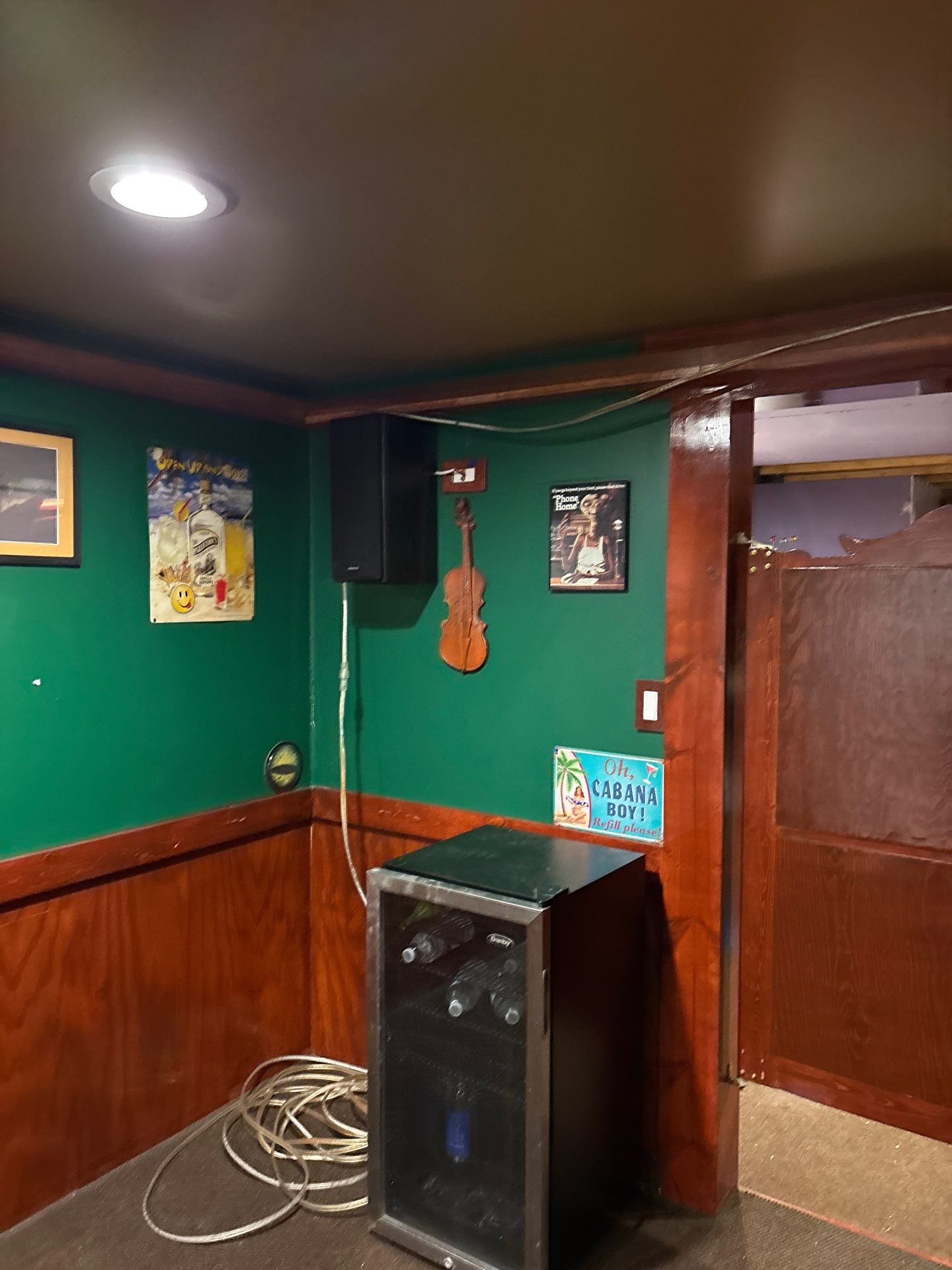
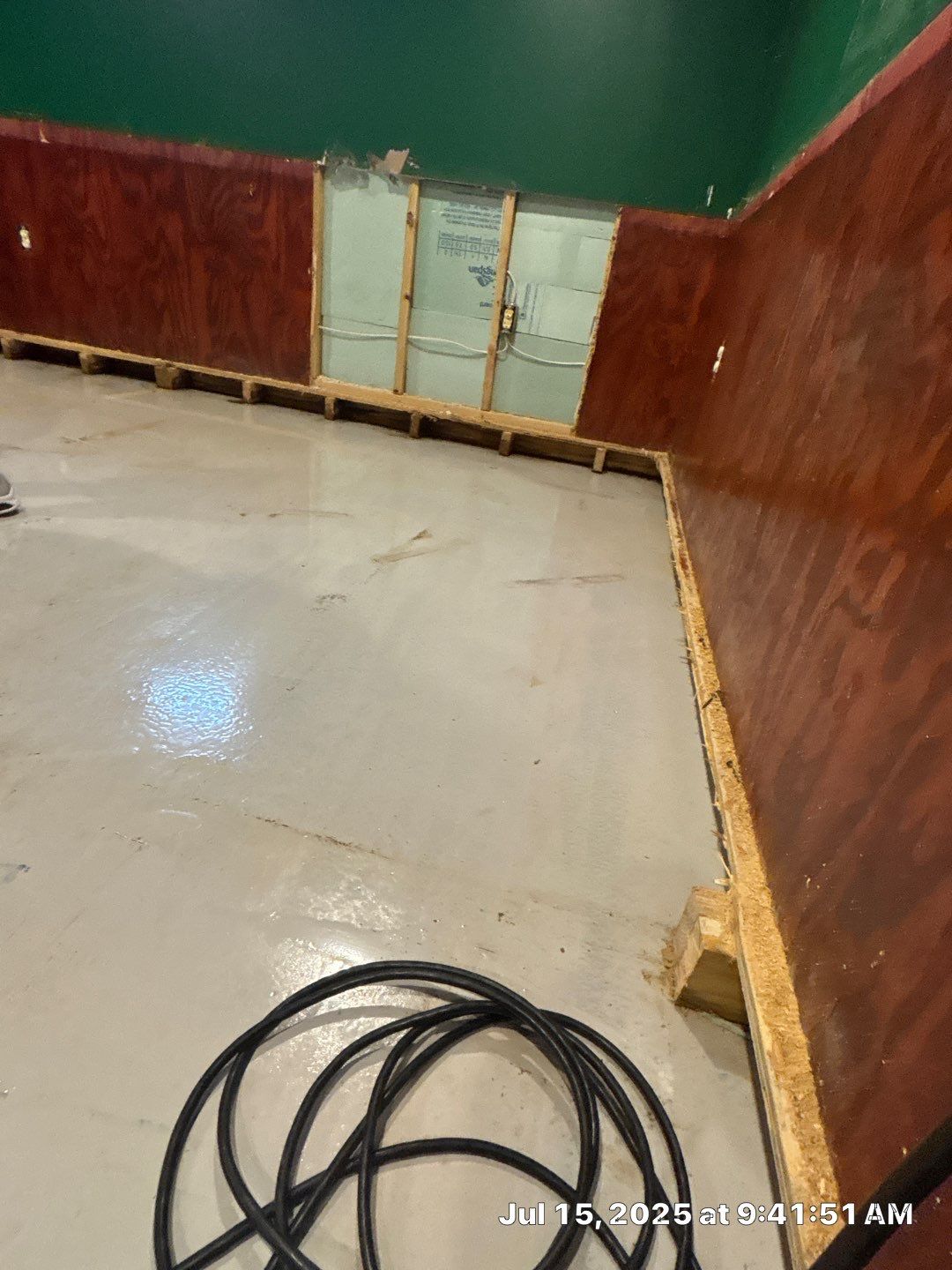
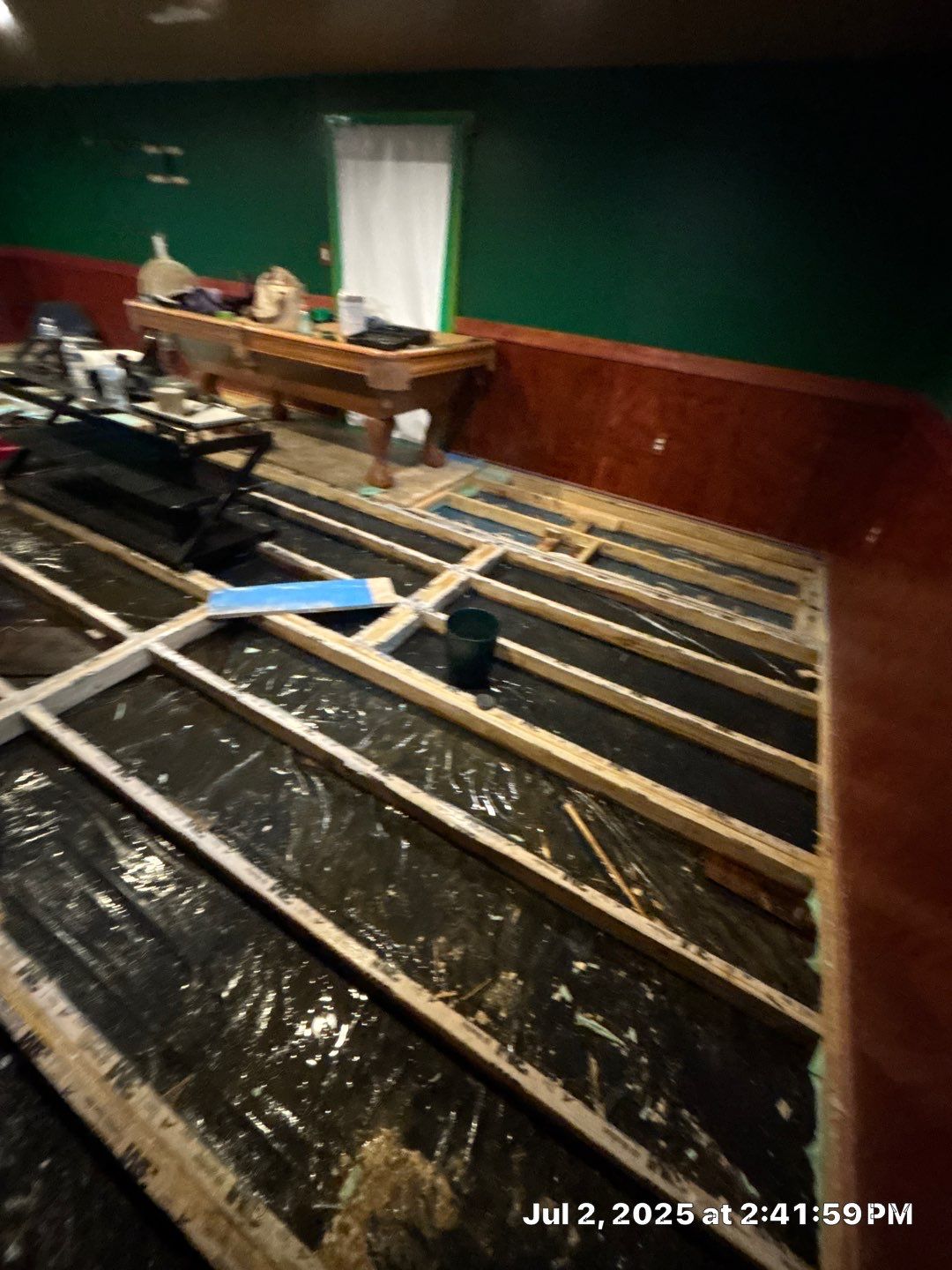
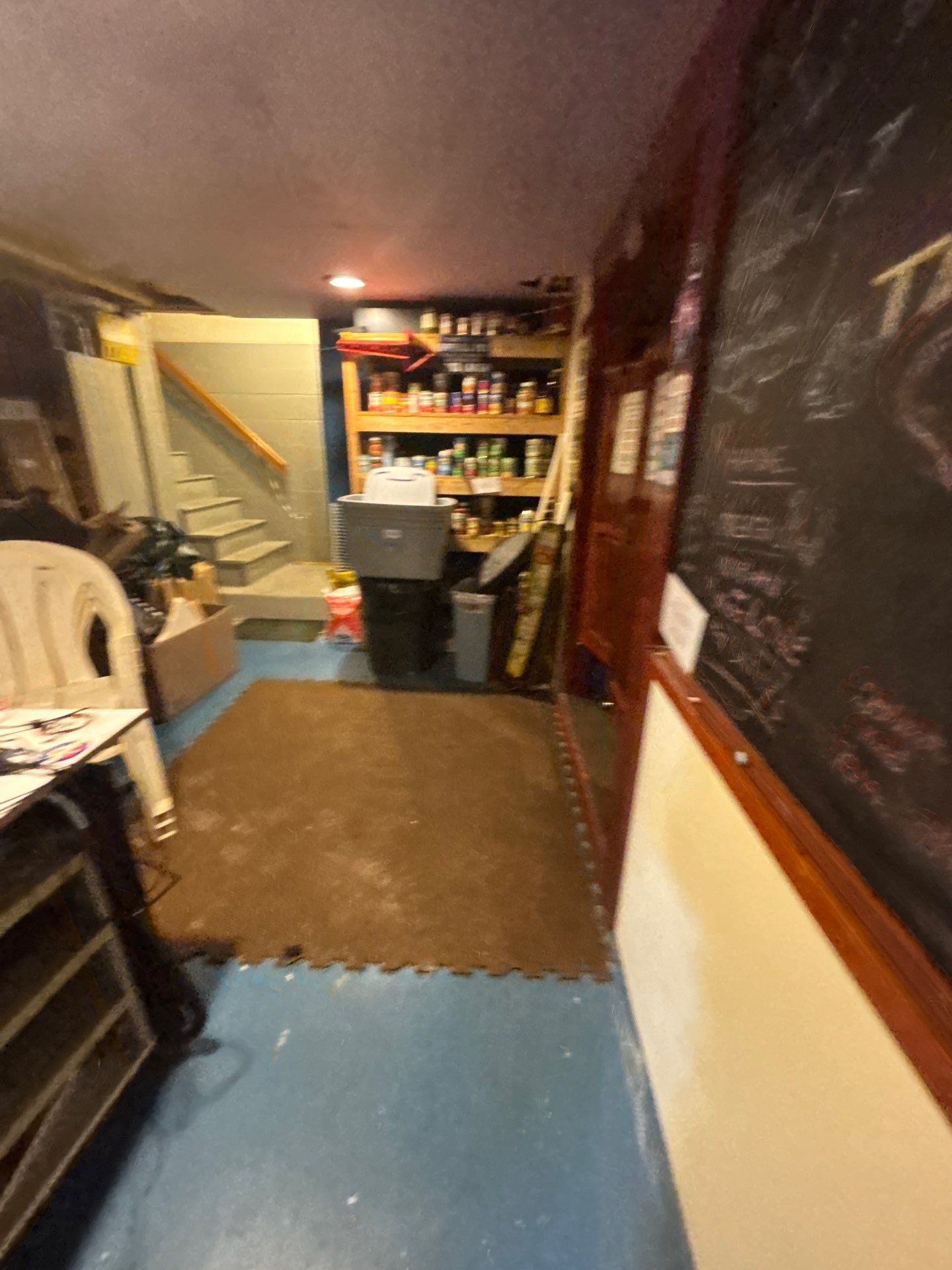
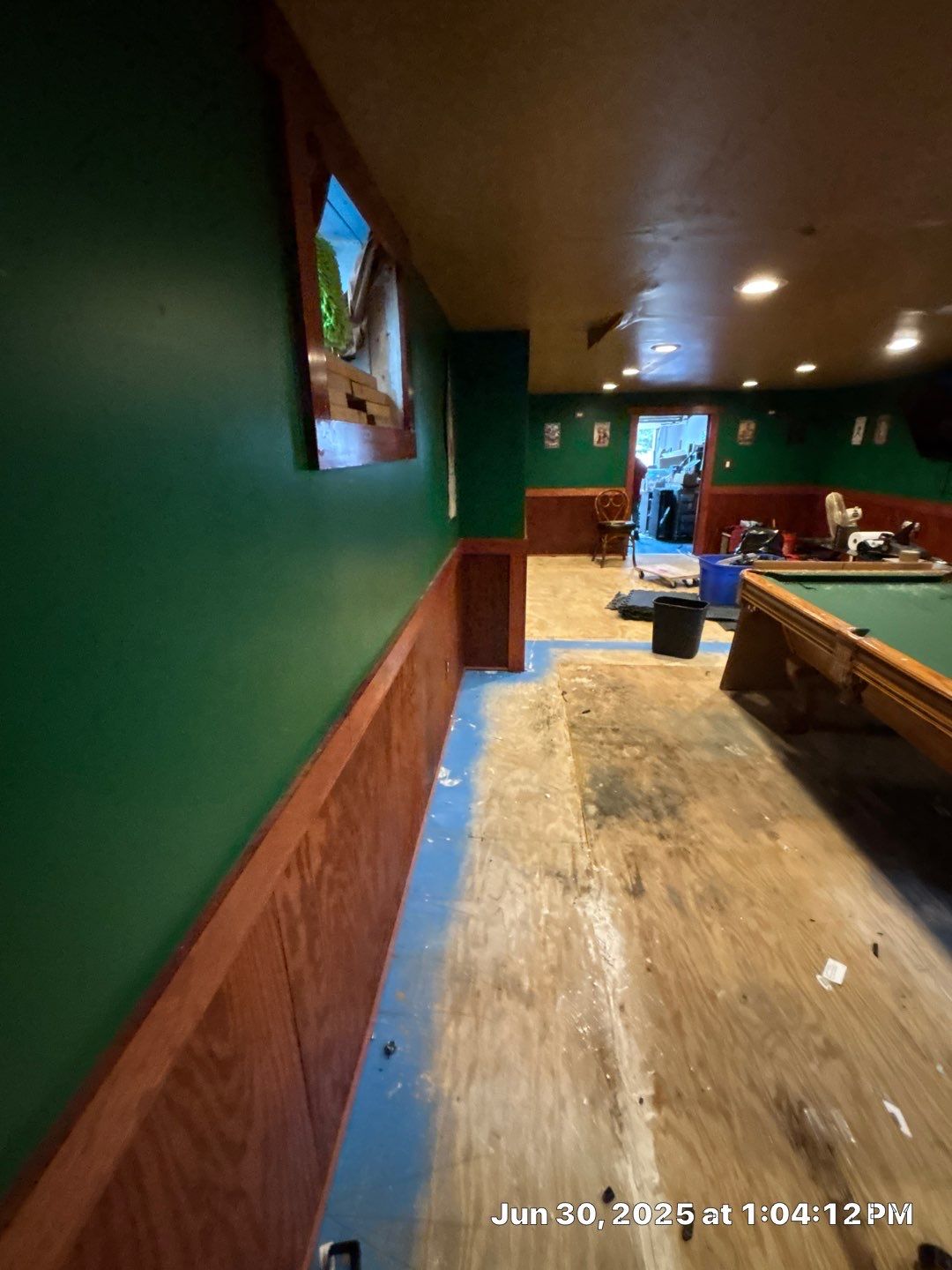
The basement presented the most technically complex challenges of this entire reconstruction services project. The entertainment suite had been finished to a high standard — green-painted walls with custom wood wainscoting and mahogany-style paneling, a full built-in bar area, recessed lighting, a pool table as the centerpiece, and a chalk-board accent wall in the utility corridor. Water had saturated this finished assembly at multiple points, visibly pooling in the utility hallway near the staircase and migrating under the raised sleeper-subfloor system throughout the main entertainment space.
Initial assessment confirmed that the finished flooring, the subfloor panels over the sleepers, and the sleepers themselves had been compromised by moisture. More critically, fiberglass batt insulation installed within the joist bays below the sleeper system had absorbed and retained significant water volume — insulation that could not be reached by conventional drying equipment without physically removing the floor assembly. Emergency restoration near the affected areas began immediately with surface water extraction while the structural access plan was formulated.
The Pool Table Challenge
A high-quality, full-sized pool table occupied the center of the basement entertainment room. Because the limited onsite space in this Lancaster County property provided no viable staging area for a table of this size and weight, and because the homeowner’s health limitations restricted options for exterior or offsite content storage, the decision was made to work around the pool table in place. Technicians designed the floor demolition sequence to access joist cavities while keeping the pool table on its legs, carefully managing the structural sequencing to ensure the table remained stable throughout what became a weeks-long floor reconstruction process.
Main Floor: Secondary Affected Zone
Main-floor areas showed evidence of moisture migration from both above and below. Flooring materials were saturated and required removal. Wall assemblies at the lower sections showed elevated moisture readings requiring controlled demolition to the appropriate drying line. Contents throughout — including furniture, personal belongings, and notably musical instruments — were at risk from both direct moisture contact and from the elevated relative humidity that pervades a structure with this volume of trapped water.
Upper Level: Bathroom and Bedroom Zone
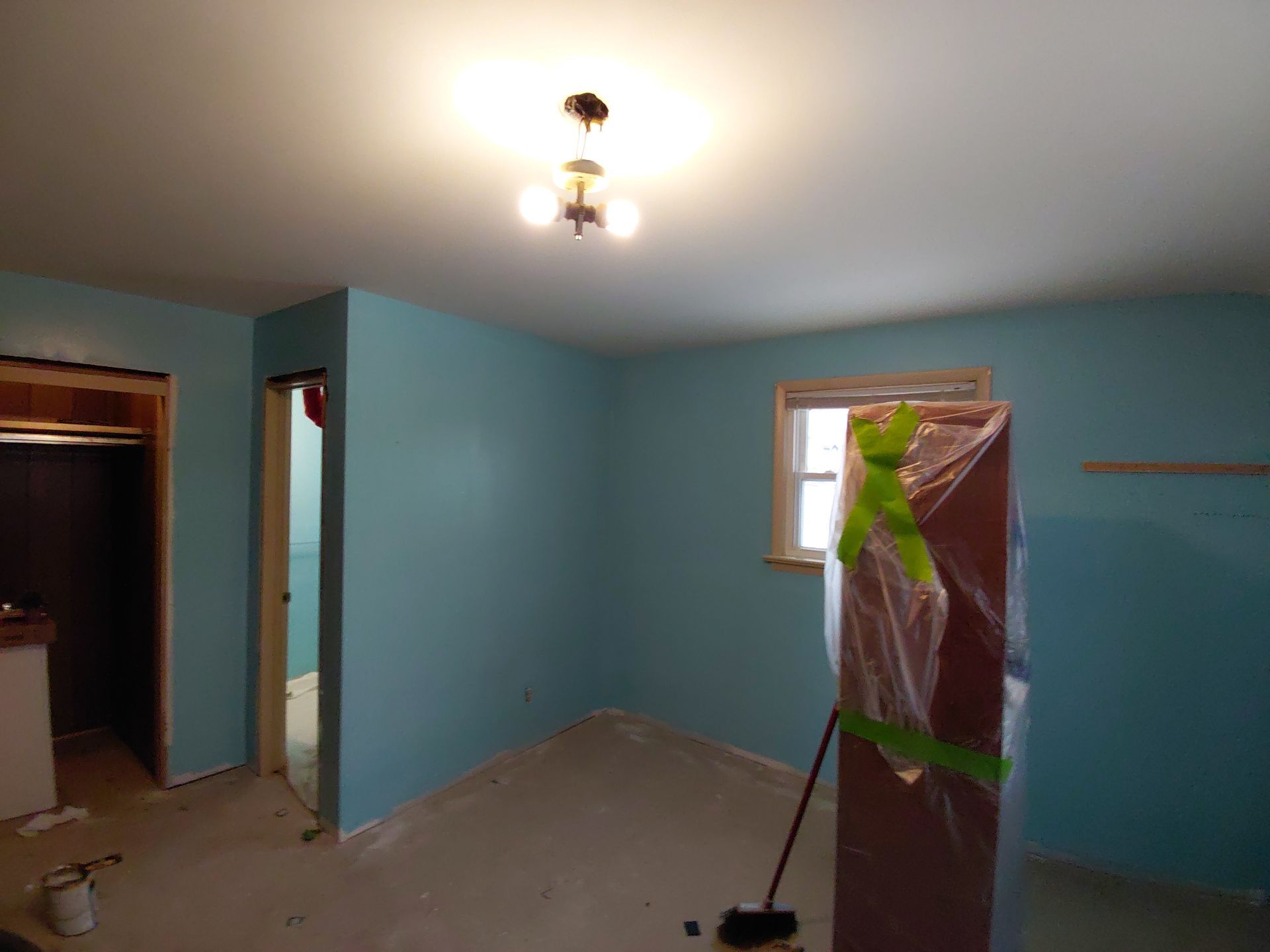
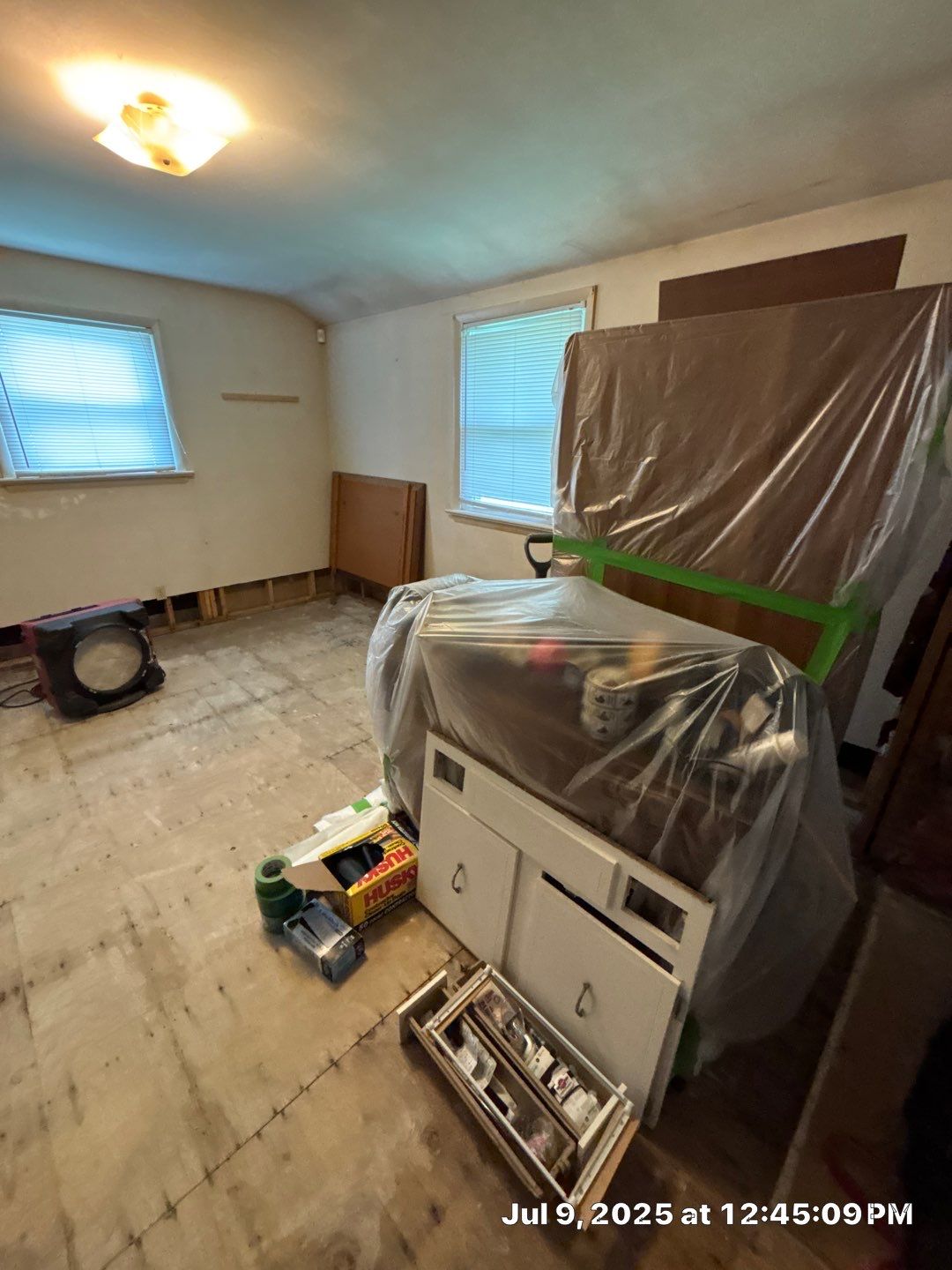
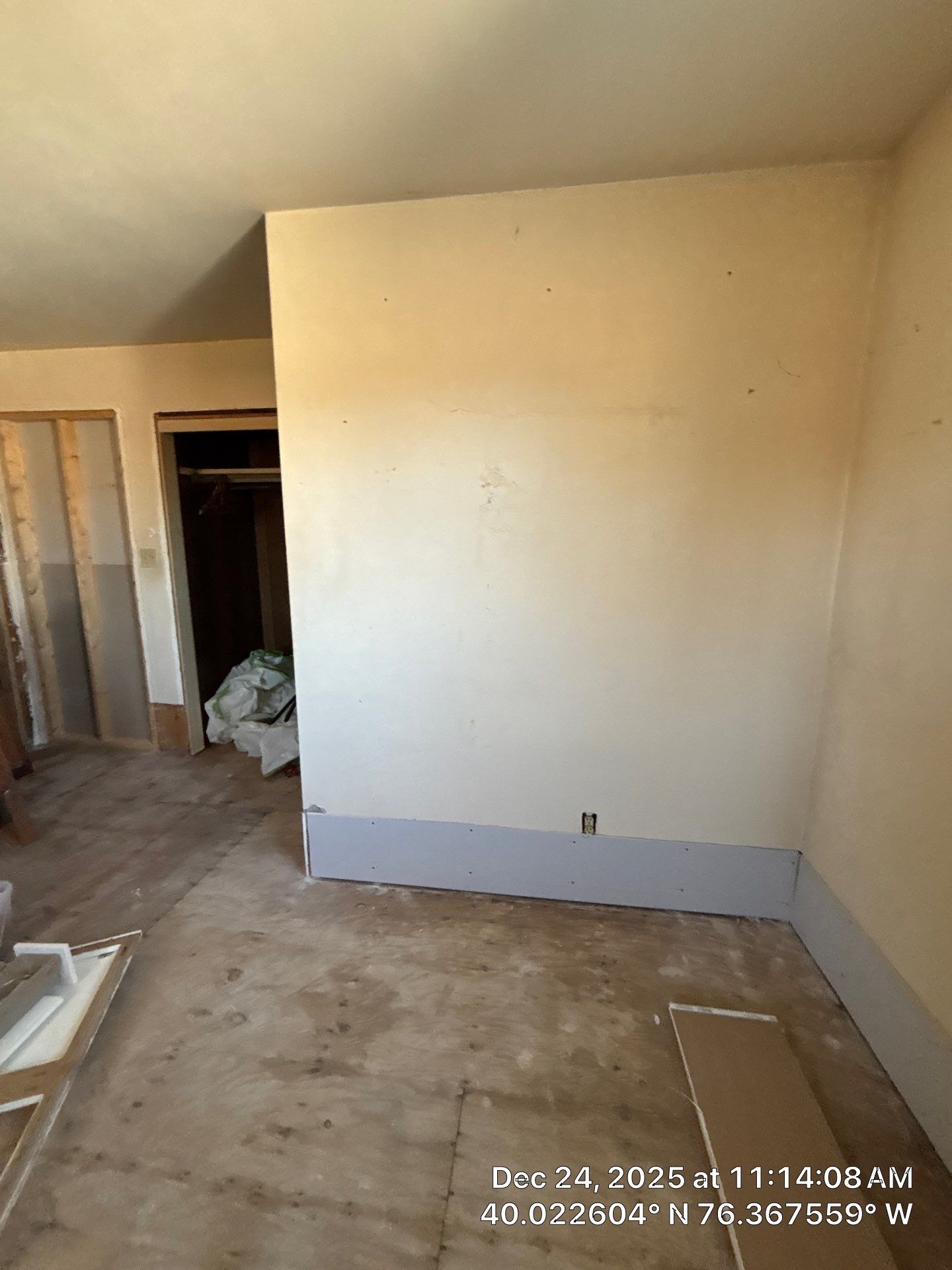
The upper-level bathroom and the adjoining bedroom showed damage consistent with downward water migration and direct fixture-area exposure. The bedroom required flooring removal to expose the subfloor for drying access, and wall assemblies were partially demolished to allow air movement through the stud cavities. Ceiling assemblies also required attention, as fiberglass batt insulation between the floor joists had absorbed moisture and was holding it against the structural framing.
Response Strategy
Emergency Night Response and Immediate Stabilization
Harrisburg Restoration’s night-response capability proved decisive in this case. Arriving during the overnight hours, the first priority was stopping any active water source, followed by immediate surface extraction throughout all affected levels. Dehumidification equipment was staged in the most critically saturated zones, and the scope documentation process — critical for carrier authorization of this level of reconstruction services — began before dawn. Photographic evidence captured the full extent of water presence in each zone, establishing the baseline that would support every subsequent claim element.
Content Pack-Out: Musical Instruments and High-Value Items
A structured content pack-out was executed to remove moveable high-value contents from the affected zones. This included musical instruments — items that are particularly vulnerable to moisture damage due to their sensitivity to humidity fluctuation — along with furniture, personal effects, and decorative items throughout the home. A detailed inventory was maintained for each packed item, and items were moved to climate-controlled staging to prevent secondary damage during the extended restoration timeline. Content that could not be moved — most notably the pool table — was documented and protected in place.
Containment System Construction
Given the homeowner’s documented health limitations, professional containment systems were erected prior to any demolition activity. Physical containment barriers isolated the active work zones, preventing demolition dust, debris particles, mold spores, and elevated particulate matter from migrating into the occupied areas of the home. This was not simply a best-practice measure — for this homeowner, containment was a medical necessity that informed every phase of the project sequencing.
Harrisburg Restoration’s Multi-Phase Reconstruction Services Approach
Controlled Demolition and Structural Access
Why Floor Joist and Sleeper Removal Was Necessary
The defining technical challenge of this reconstruction services project was the trapped moisture beneath the basement’s sleeper-subfloor system. A sleeper system — rows of pressure-treated lumber installed directly on the concrete slab to create a raised floor plane — creates enclosed cavities that standard air movers and dehumidifiers cannot effectively penetrate. Water that entered these cavities and saturated the fiberglass batt insulation installed within them had to be physically accessed by removing the floor assembly from above.
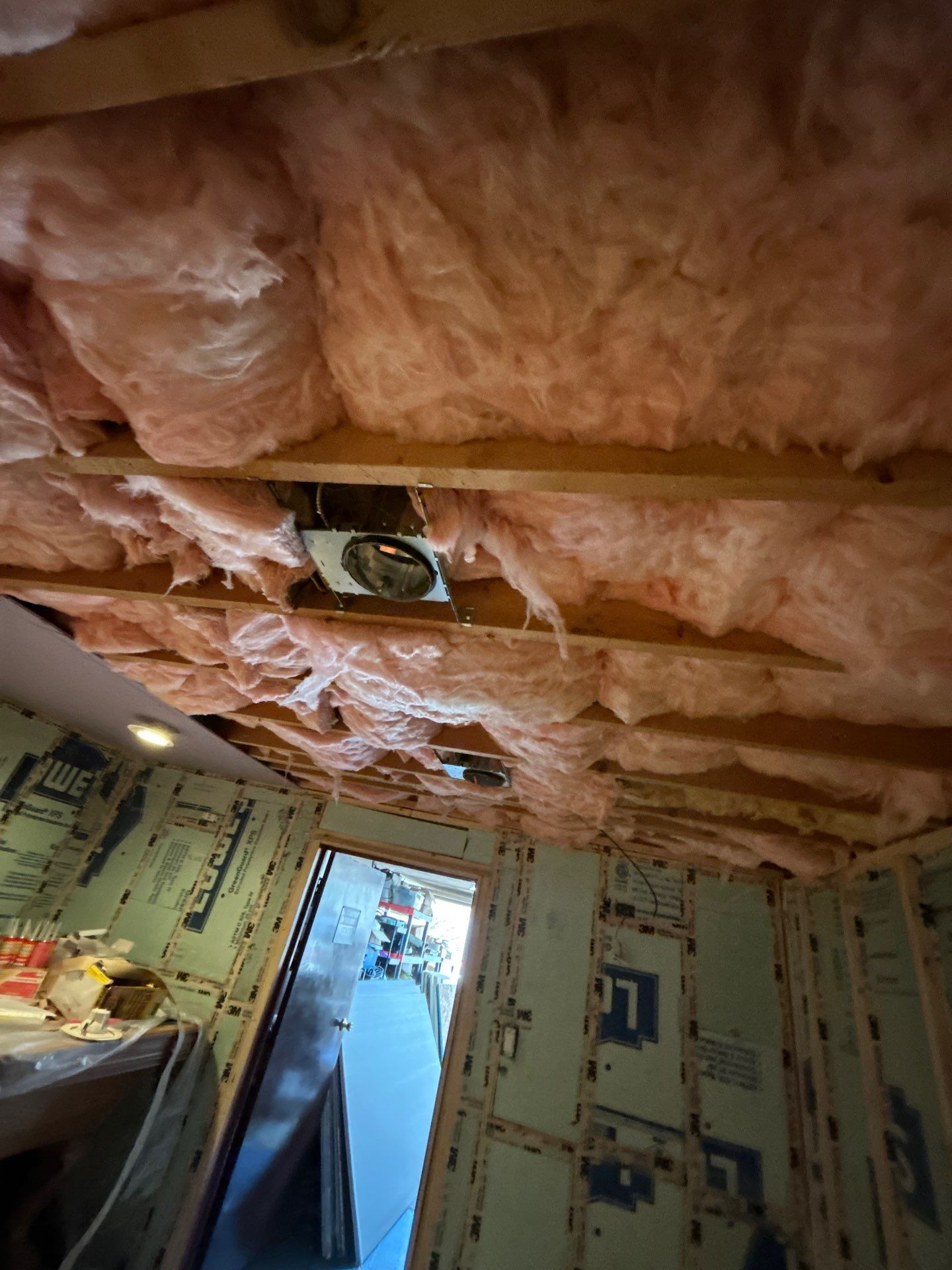
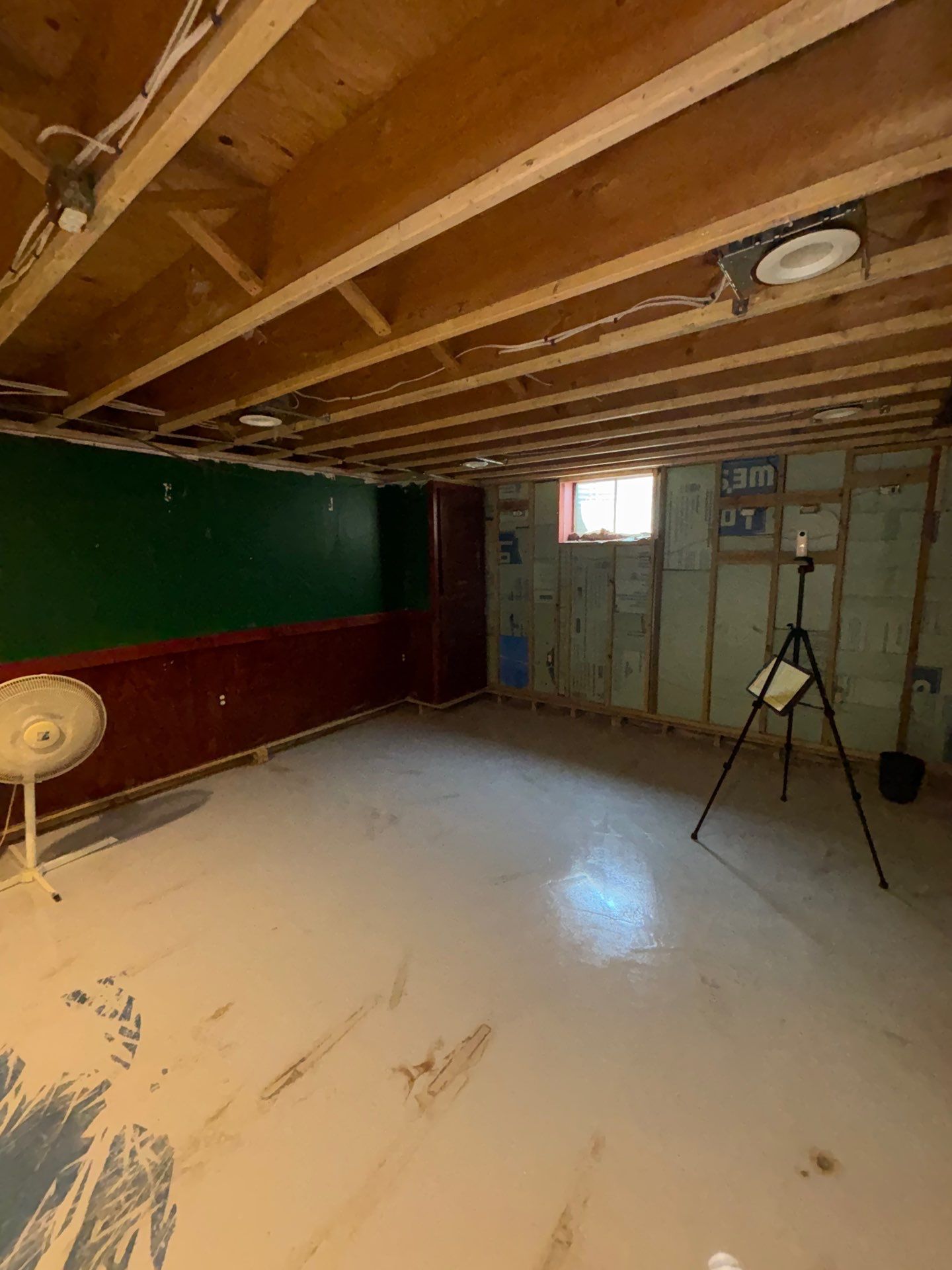
Technicians systematically removed the finished flooring, subfloor panels, and the sleeper framing members in coordinated sections, exposing the concrete slab and its trapped moisture. This revealed the full extent of the insulation saturation — pink fiberglass batt material that had absorbed and held water against the structural framing, creating sustained elevated moisture conditions that would have guaranteed mold growth if left unaddressed. All saturated insulation was removed, disposed of in accordance with PA DEP protocols, and the cavities were dried to verified moisture content levels before any re-framing was permitted.
Upper Level: Ceiling and Wall Assembly Access
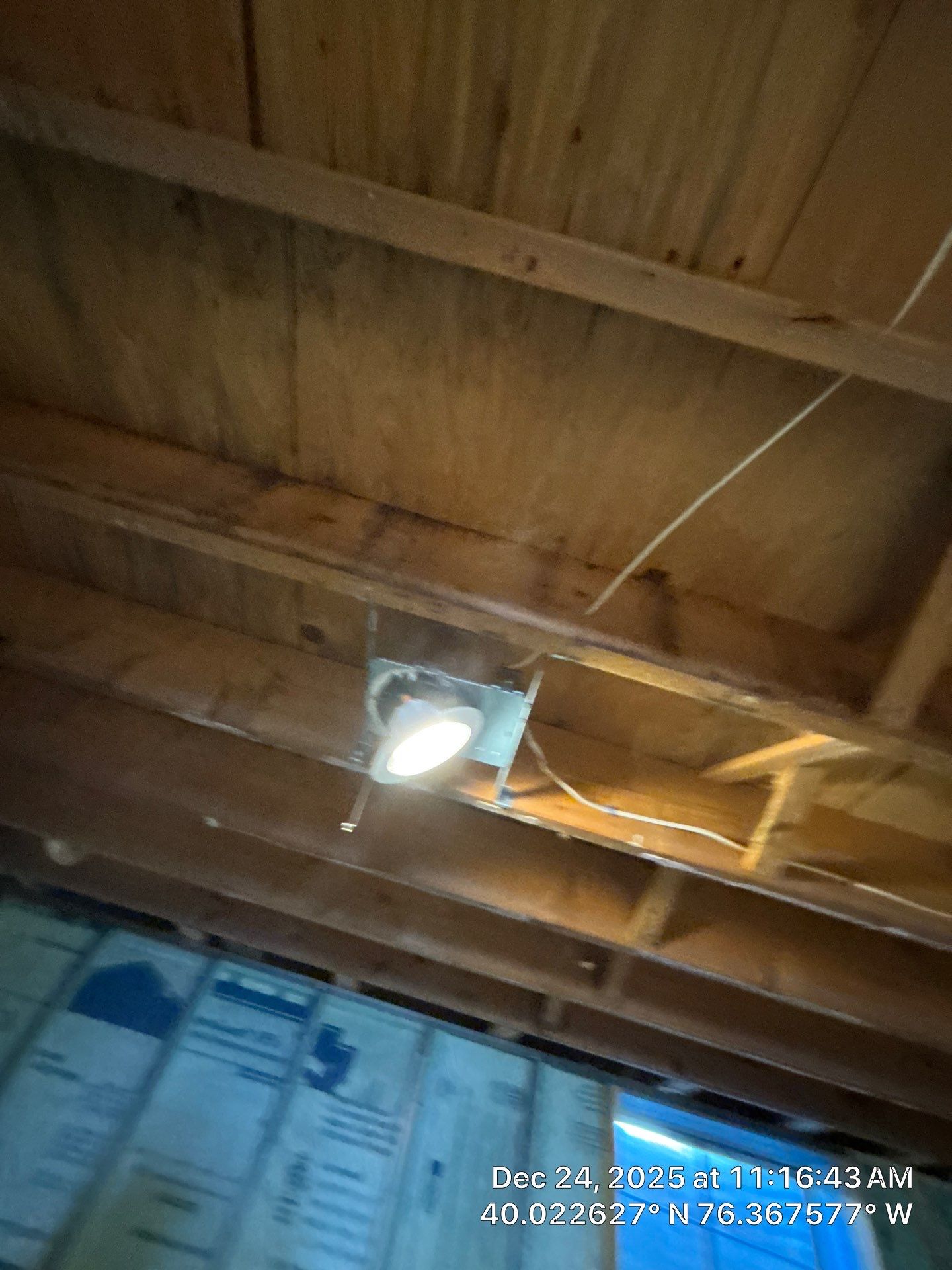
On the upper level, ceiling assemblies required opening to expose the floor joist bays and the fiberglass insulation between them. Photos documented the extent of insulation saturation — batt material visible between the ceiling joists, heavy with absorbed moisture. Wall assemblies were partially demolished to appropriate drying lines, and the standard flood cut methodology was applied where moisture readings confirmed wicking had occurred above the visible water line.
Mold Remediation Integration
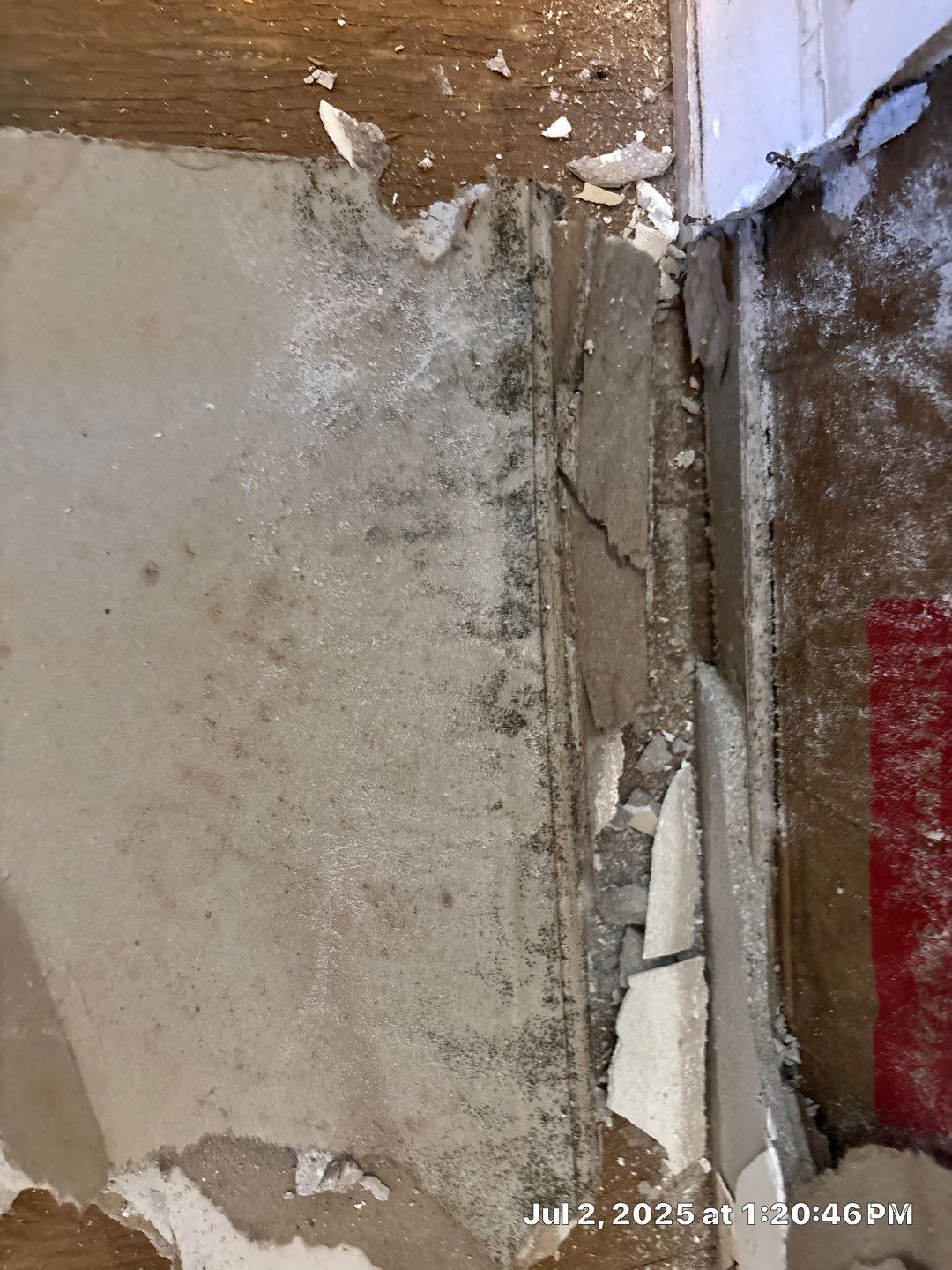
Active mold growth was confirmed during the demolition phase, particularly at concrete block wall interfaces and at the lower sections of drywall assemblies in the basement. Close examination of wall surfaces revealed established mold colonies, consistent with the multi-day exposure window between the overnight water intrusion event and the full demolition phase. Mold remediation was integrated into the reconstruction services scope, with affected materials removed and structural surfaces treated prior to any enclosure or rebuild activity.
Equipment Deployment Analysis
Given the multi-level nature of this loss and the requirement to dry both above-slab and below-slab assemblies, equipment was strategically staged across all three floors simultaneously. The priority during structural drying was achieving adequate air exchange within the exposed joist bays and open wall cavities — conditions that require positioned axial air movers working in concert with commercial-grade dehumidification to achieve drying goals within carrier-mandated timeframes.
🌀 Axial Air Movers — Multi-Level Deployment
High-velocity axial air movers were positioned throughout all three affected levels, with particular concentration in the basement where the exposed joist cavities required sustained directional airflow to accelerate evaporation from the concrete slab and structural framing surfaces. Units were repositioned as the drying front progressed through each zone.
Slab & joist cavity drying
Flat slab-directed & wall-angled
Basement, main floor, upper level
Phased with demolition sequence
💧 Commercial Dehumidifiers — LGR Technology
Low-grain refrigerant (LGR) dehumidifiers were deployed to maintain aggressive relative humidity drawdown throughout all active zones. In an enclosed basement with this volume of exposed structural wood and concrete, sustained dehumidification prevents moisture re-absorption into framing members as evaporation occurs — a critical function during the post-demolition, pre-rebuild drying phase.
Low-Grain Refrigerant (LGR)
All three affected levels
Daily moisture reading documentation
Continuous through drying phase
📡 Moisture Monitoring System — Tripod-Mounted
Professional moisture monitoring equipment, including tripod-mounted data loggers capturing temperature, relative humidity, and dew point, was staged in the primary work zone. This real-time data collection provided the carrier-compliant drying logs required for reconstruction services authorization at each subsequent phase — a documentation requirement that distinguishes professional restoration from unlicensed contractors.
Temp, RH, dew point, moisture content
Continuous automatic recording
Carrier documentation compliance
Phase-by-phase progress reports
Carrier Documentation and High-End Material Verification
Proving the Value of What Was Lost
Insurance carriers scrutinize material replacement claims on high-end finished spaces, and the Lancaster County property presented multiple categories of premium materials that required comprehensive documentation. The custom-built wood wainscoting and mahogany-stained paneling throughout the basement entertainment suite, the built-in bar structures, the recessed lighting systems, and the high-quality flooring materials installed throughout the home all needed to be itemized, valued, and matched to carrier-acceptable comparable specifications before any reconstruction services work could proceed with authorization.
Harrisburg Restoration’s documentation team captured detailed photographic evidence of each material category prior to demolition — ensuring that no information critical to the carrier claim was lost once demolition began. Material samples were retained where appropriate, and manufacturer specifications for matching replacement materials were sourced and submitted alongside the claim documentation. This carrier-first documentation approach prevented the delays and disputes that commonly arise when high-end material claims lack sufficient pre-demolition evidence.
Subfloor Leveling: A Hidden Complexity
One of the less visible but technically demanding aspects of this reconstruction services project was the condition of the existing subfloor system. The home’s original construction had produced significantly unlevel subfloor conditions — variations in plane that had been masked by the original finished floor assemblies but that became fully apparent once demolition exposed the substrate. Installing new finished flooring to a level, industry-standard specification required correction of these underlying conditions before any finish material could be installed.
The team employed a systematic leveling approach: self-leveling compound applications in areas with concave low points, and careful planing or shimming of elevated areas, building up a corrected substrate that would support a high-quality finished floor product. This additional scope was documented and submitted as a carrier-required code-compliance item — bringing the rebuilt assembly into compliance with current flooring installation standards that the original construction had not met.
New Floor Build-Out to Match Existing
With the basement sleeper system removed and the concrete slab dried and verified, the reconstruction services team rebuilt the floor assembly from the slab upward. New sleepers were installed to the corrected elevation, new subfloor panels were applied, and the finished luxury vinyl plank flooring was installed to match the aesthetic character of the adjoining spaces that had not been affected. The finished result — visible in the completed before-and-after documentation — shows a level, visually consistent finished floor that integrates seamlessly with the restored wainscoting and rebuilt entertainment space.
Project Data & Analytics
Affected Area Distribution
Levels
Basement Entertainment (45%)
Main Floor Living (25%)
Upper Bathroom/Bedroom (20%)
Structural/Framing (10%)
Emergency Restoration Near You: Response Impact
Reconstruction Services Scope Complexity Breakdown
Restoration Timeline and Methodology
Emergency Restoration Coverage Across Central Pennsylvania
Response Times from Harrisburg HQ
Lancaster County, PA and the South-Central Pennsylvania Region: Understanding Local Water Damage Risks
South-central Pennsylvania presents a specific set of conditions that elevate water damage risk for residential properties throughout Lancaster and York Counties. The region’s older housing stock — much of it constructed in the mid-twentieth century with materials and methods that don’t meet current moisture management standards — frequently features the type of sleeper-over-slab basement construction documented in this case. These assemblies were common in post-war residential construction and remain in widespread use throughout Lancaster County communities including the 17602 and 17603 ZIP codes.
Regional Factors Affecting Water Damage Risk
Pennsylvania’s seasonal precipitation patterns produce periods of sustained ground saturation, particularly in the late winter and early spring thaw periods when frozen ground gives way to heavy rainfall. Lancaster County’s Susquehanna River watershed creates additional drainage complexity in lower-elevation residential areas. For older homes with finished basements on sleeper systems, these conditions create an elevated chronic risk profile that makes finding emergency restoration near your location a priority, not an afterthought.
Why Lancaster and York County Homeowners Choose Harrisburg Restoration
Harrisburg Restoration operates from 17111 as a central hub for rapid deployment throughout Dauphin, Cumberland, York, and Lancaster Counties. The reconstruction services capability documented in this case study — from overnight emergency response through precision finish matching and carrier documentation — reflects the full-service model that homeowners in communities from Harrisburg to Lancaster require when a significant water loss event occurs. Our night-response protocol and 24/7 dispatch ensure that when a water intrusion occurs at 2:00 AM in Lancaster County, a qualified team is on the road within minutes.
Project Documentation Gallery
The following table summarizes the damage assessment, demolition scope, and reconstruction services outcomes across each affected zone in this Lancaster County water damage project.
| Zone | Damage Type | Demolition Scope | Reconstruction Outcome |
|---|---|---|---|
| Basement Entertainment Room | Standing water, saturated sleeper system, mold on concrete | Full floor removal (finish, subfloor, sleepers), insulation extraction | New sleeper system, level-corrected subfloor, matched LVP flooring installed |
| Basement Utility Corridor | Standing water pooling, wall base saturation | Flooring removed, lower wall assemblies demoed to drying line | Walls rebuilt, floor replaced, corridor restored to function |
| Main Floor Living Areas | Moisture migration, elevated humidity, flooring saturation | Flooring removed, lower walls demoed, contents packed out | Subfloor leveled, new flooring installed, contents returned |
| Upper Bathroom | Fixture-area saturation, wall and ceiling wicking | Ceiling opened, wall assemblies demoed, insulation removed | New insulation, walls rebuilt, bathroom restored |
| Upper Bedroom | Water migration, flooring saturation, lower wall wicking | Flooring removed, partial wall demo, contents protected in place | Subfloor dried and leveled, new flooring installed, room restored |
Key Takeaways: What This Reconstruction Services Project Demonstrates
The Lancaster County water damage project illustrates the full spectrum of challenges that a complex residential water loss can present — and why a contractor capable of delivering true reconstruction services, not just mitigation, is essential for property owners facing multi-level events. Several lessons emerge from this project that are directly applicable to any homeowner or property manager in the Harrisburg-to-Lancaster corridor.
First, overnight water intrusion events in homes with finished basement floor systems are disproportionately destructive. The physics of water migration under a sleeper-subfloor assembly means that trapped moisture cannot be addressed without physical demolition — a scope requirement that many general contractors and even some mitigation companies are not equipped to execute with the precision required for carrier documentation compliance.
Second, emergency restoration near your location matters enormously in multi-level losses. Every hour that water remains trapped within structural assemblies is an hour in which mold activation risk increases — particularly dangerous for homeowners with health limitations, as documented in this case. Harrisburg Restoration’s overnight response capability directly reduced the mold colonization scope and protected a vulnerable occupant.
Third, high-end material claims require proactive, pre-demolition documentation. The custom wainscoting, built-in bar structures, and finish flooring in this Lancaster County entertainment suite would have been impossible to document accurately after demolition. Carrier authorization for matching replacement materials depends entirely on the quality of evidence captured before the first board is removed.
Harrisburg Restoration’s reconstruction services capabilities — built on 24/7 emergency response, structural demolition expertise, carrier-compliant documentation, and precision finish matching — make us the preferred choice for property owners throughout central Pennsylvania who need more than a pump and a fan. Call (717) 232-5444 for emergency restoration near you, any hour of the day or night.
Contact Harrisburg Restoration — 24/7 Emergency Response
Phone: (717) 232-5444 — Available 24 hours, 7 days a week
Service Area: Dauphin, Cumberland, York, Lancaster, Perry, and Lebanon Counties, Pennsylvania
Reconstruction Services: Water damage, fire damage, mold remediation, structural rebuild, content pack-out, carrier documentation
Response Commitment: Emergency restoration near you — night response available throughout central PA including Lancaster County ZIP codes 17601, 17602, 17603, 17606